
Ads keep getting pricier, and social media reach is unpredictable with shifting algorithms. Yet one channel continues to deliver consistent results, affiliate marketing, which drives 16% of all Shopify DTC sales worldwide.
The affiliate marketing industry is projected to reach $27.8 billion by 2027, and Shopify store owners who act now can secure a big share of that growth.
Launching an affiliate program for word-of-mouth marketing in Shopify is cost-effective. In addition, it also builds trust, expands reach, and accelerates your sales without the constant ad spend.
In this guide, you’ll learn:
- What Shopify affiliate marketing is and how it works
- Benefits for Shopify stores that use affiliate programs
- Step-by-step guide to launch and manage your affiliate program
- Popular Shopify apps for affiliate marketing setup
- Best practices and advanced strategies to scale campaigns and increase ROI
By the end, you’ll know exactly how to start, run, and grow a Shopify affiliate program that drives measurable sales and long-term revenue.
Table of contents
- What is Shopify Affiliate Marketing?
- Benefits for Shopify Store Owners Using Affiliate Marketing
- How Shopify Affiliate Marketing Works
- Best Practices for Running a Successful Affiliate Program
- Shopify Affiliate Marketing vs. Other Marketing
- Affiliate Marketing in Shopify: Pros and Cons
- Popular Shopify Apps for Affiliate Marketing
- How to Install and Set Up Affiliate Marketing Apps on Shopify
- Step-by-Step Guide to Launch Your Affiliate Program in Shopify
- Managing and Scaling Your Affiliate Program
- Advanced Strategies and Tips to Run Affiliate Campaigns
- Measuring ROI: Analyzing the Performance of Affiliate Marketing
- Common Mistakes to Avoid in Affiliate Marketing for Shopify
- Case Study: Success Story Using Affiliate Marketing
- Conclusion
- Frequently Asked Question
Save Time, Earn More – Automate Your Shopify Affiliate Marketing in Minutes!
What is Shopify Affiliate Marketing?
Shopify affiliate marketing is an approach where businesses join hands with affiliate partners to drive sales. Following this, affiliates earn a commission for every sale they generate.
They promote your store using unique affiliate links in Shopify, thus making it easy to track performance and attribute revenue accurately.
Through my experience, I’ve discovered that a successful Shopify affiliate program goes beyond attractive commission rates.
Consequently, you must recruit genuine affiliate partners and create a reliable system to promote affiliate products.
This trust-based word-of-mouth marketing increases customer loyalty, boosts retention, builds brand awareness, and also accelerates store growth effortlessly.
Benefits for Shopify Store Owners Using Affiliate Marketing
Let me share what I’ve consistently observed Shopify owners earn while running affiliate programs apart from sales and revenue.
Industry reports confirm the affiliate marketing space is expanding at an annual growth rate of 10%, making it a consistently strong channel for e-commerce brands.
Furthermore, here are the proven benefits you can expect from affiliate marketing in Shopify:
keting partnerships are:
Zero Upfront Marketing Costs
Affiliates are only paid when they drive sales. Hence, you can avoid high ad budgets and risky upfront spending.
For instance, if you are running dropshipping in Shopify, then this financial structure will be best for you.
Easy Monitoring of Affiliate Sales
With a Shopify affiliate marketing app, you can get a clear dashboard and advanced tracking. Thus, this gives you full visibility into affiliate sales, commissions, and performance.
High Growth Through Wide Reach
If you recruit popular partners in your affiliate marketing niche, you can make your Shopify products reach a wider audience. You can reach target customers without extra work from you.
Better ROI Than Traditional Marketing
Because it runs on a pay-for-performance model, Shopify affiliate marketing delivers higher ROI. Moreover, lower costs and performance-based payouts make it more effective than traditional ads.
How Shopify Affiliate Marketing Works
Having tested multiple Shopify affiliate tools, I can break the process into simple steps anyone can follow.
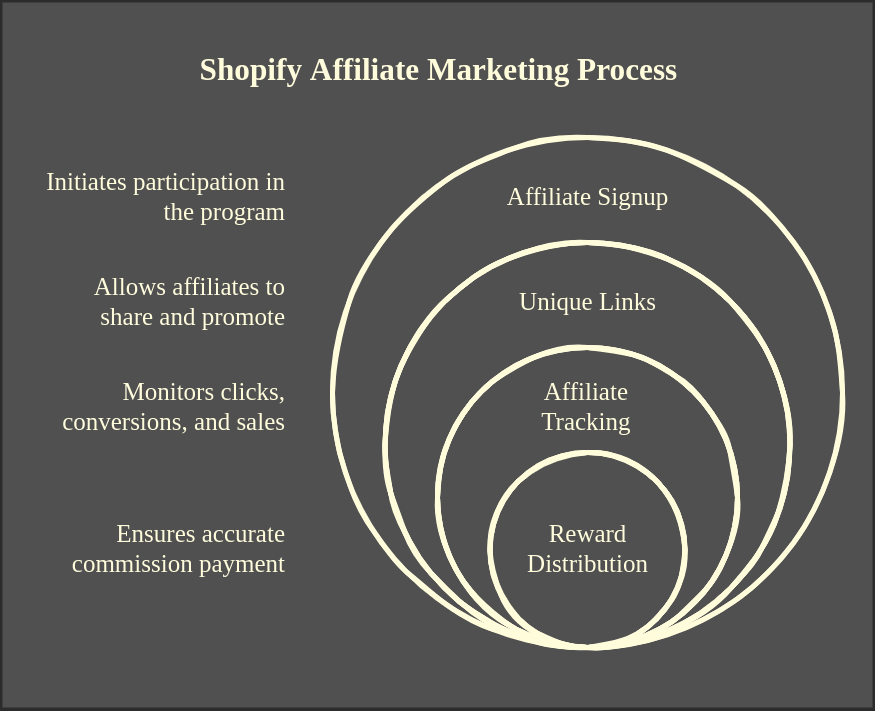
- Step 1: Affiliate Signup: Affiliates join your Shopify affiliate program using a dedicated signup form on the affiliate landing page.
- Step 2: Share Affiliate Links: Then, they receive a unique Shopify affiliate link to promote across social media, websites, or email campaigns.
- Step 3: Track Performance: Following that, with Shopify affiliate tracking, you can monitor every click, referral, and sale in real time.
- Step 4: Automate Commission Payouts: Shopify commission models are automatically calculated, and then affiliates get paid on time without manual work.
This streamlined process ensures every sale in my Shopify referral program is tracked accurately, affiliates are rewarded fairly, and then you can scale revenue with confidence.
For example, Shopify pays $150 for every referral that converts into a paying customer, showing how lucrative structured affiliate programs can be.
Best Practices for Running a Successful Affiliate Program
Through years of testing and scaling Shopify affiliate marketing campaigns, I’ve found a few best practices for starting an affiliate program that work.
- Implement the Best Shopify Affiliate Software
I use Shopify affiliate apps like Yuko Affiliate Marketing to automate tracking, payouts, and reporting. Thus, it saves me hours of manual work and lets me focus on growth tasks that need my attention.
The right software also reduces errors and ensures affiliates trust the system.
Furthermore, you can discover the best tools for affiliate marketing in our blog on the Shopify Affiliate Marketing App.
- Create Compelling Shopify Commission Rates
Attractive Shopify commission rates motivate affiliates to sell more. Hence, I realized one shouldn’t stop at flat rates. So, test tiered and recurring commissions.
Affiliates see that extra effort gets rewarded, and so, in return, your program will get higher-quality referrals.
- Use Effective Shopify Affiliate Management Tools
I rely on affiliate tracking tools and reporting dashboards to measure clicks, conversions, and revenue.
As a result, these insights show which products convert best and which partners are driving value. Hence, for me, this data doubles as a customer behavior report without extra cost.
- Maintain Strong Shopify Marketing Partnerships
Affiliates are not just partners, but brand advocates. Hence, I recommend focusing on building long-term trust by paying commissions on time, offering high-quality assets, and keeping communication clear.
Thus, affiliates will stay motivated and loyal to your Shopify store. Additionally, you can also turn customers into brand advocates effortlessly.
Shopify Affiliate Marketing vs. Other Marketing
I often get asked why I recommend affiliate marketing over traditional methods for a Shopify store. The truth is simple: this digital-first world needs digital marketing solutions.
Recent surveys show brands using affiliate marketing achieve an average ROI of $15 for every $1 spent (2025 data).
Hence, no more paying for print ads per page or investing in campaigns with unpredictable returns.
When I compare e-commerce affiliate marketing with traditional channels, here’s what I see:
Traditional Marketing
- High upfront costs and heavy budgets.
- Quick exposure but inconsistent ROI.
- Limited tracking and poor attribution.I.
Shopify Affiliate Program
- Performance-based payments only when sales happen.
- Predictable growth and higher long-term ROI.
- Full visibility with Shopify affiliate tracking dashboards.
For me, the difference is clear. Specifically, an affiliate marketing program for beginners creates sustainable partnerships, preserves ROI, and scales revenue without draining budgets.
Hence, it’s one of the most cost-efficient alternatives to traditional ads.
You can also explore how it compares with influencer marketing and other strategies in my detailed guide on Shopify Affiliate Marketing vs Influencer Marketing.
Affiliate Marketing in Shopify: Pros and Cons
No marketing can be perfect, I know. I wouldn’t be doing anyone any favor by hiding the potential cons of Shopify affiliate marketing.
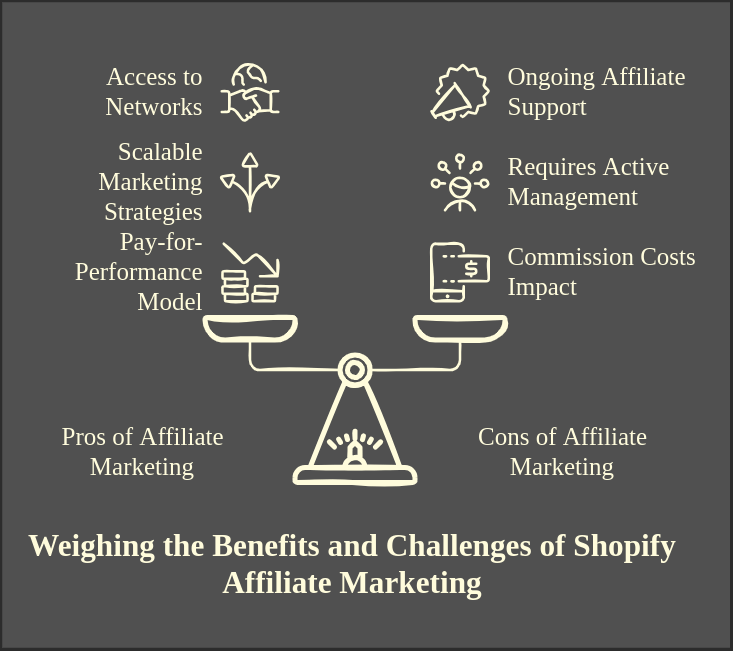
So, here is a straightforward report of the pros and cons of affiliate marketing in Shopify.
Pros:
- Pay-for-Performance Model Reduces Risk: You only pay when results are delivered.
- Scalable Shopify Marketing Strategies: Easily expand your affiliate network as your business grows.
- Access to Established Affiliate Networks: Leverage experienced affiliate marketers who are popular in your niche with proven credibility and sales records.
Cons:
- Requires Active Management: You have to maintain relationships and track performance which demands time and effort.
- Commission Costs Affect Margins: You must make sure the commission is balanced to avoid losing profits.
- Need for Ongoing Affiliate Support: Affiliates require resources and regular communication to stay motivated.
Popular Shopify Apps for Affiliate Marketing
There are various Shopify apps for referral and affiliate marketing like:
After testing dozens of Shopify affiliate tools, I recommend Yuko Affiliate Marketing as they support effortless management and automation of Shopify affiliate marketing.
I’ve found that choosing the right Shopify apps for affiliate sales can be confusing. So here are important key features you must look for before choosing a Shopify affiliate marketing app
- Automated tracking and payout systems to simplify affiliate management.
- Detailed analytics dashboards for insights into affiliate performance.
- Easy affiliate link creation for Shopify products to encourage seamless promotion.
- Strong Shopify affiliate management to handle large affiliate networks easily.
How to Install and Set Up Affiliate Marketing Apps on Shopify
Installing a Shopify affiliate marketing app is as easy as downloading an app on your mobile phone.
Go to the Shopify app store -> Enter the name of the Shopify app you need to install, and Click the Install button.
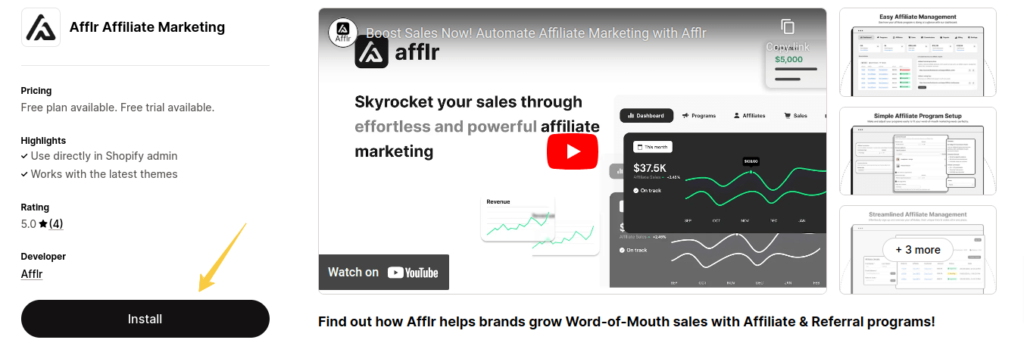
Most apps have an easy setting up of the app that is favorable even for people without coding knowledge.
In the case of installing Yuko Affiliate Marketing, they guide step by step in onboarding. Apart from this, they also have a dedicated support team for personalized onboarding.
Use the Shopify affiliate program that drives sales, increases customer loyalty, and brings in consistent sales.
Step-by-Step Guide to Launch Your Affiliate Program in Shopify
Is there too much theory on how Shopify affiliate marketing is the best for your store? Are you someone who wants to practically experiment before making your decision?
Well, I have here a step-by-step guide to launch your affiliate program in Shopify.
Since, out of many Shopify affiliate apps I used I find Yuko Affiliate Marketing very user-friendly, I am going to use that for explanation here.
Create a Shopify Affiliate Program
To create a Shopify Affiliate Program using Yuko Affiliate Marketing:
- Go to your Shopify admin dashboard.
- Navigate to Apps > Yuko Affiliate Marketing > Programs.
- Click on the Add Program button.
If you think that’s simple, wait till I tell you how simple customizing your program is.
They have pre-designed templates for affiliate programs in Shopify that are commonly preferred in addition to provisions to customize from scratch.
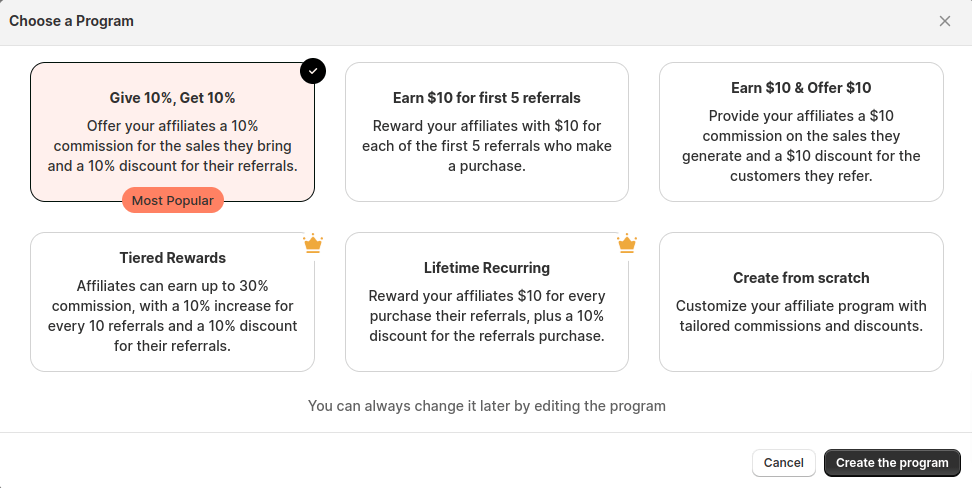
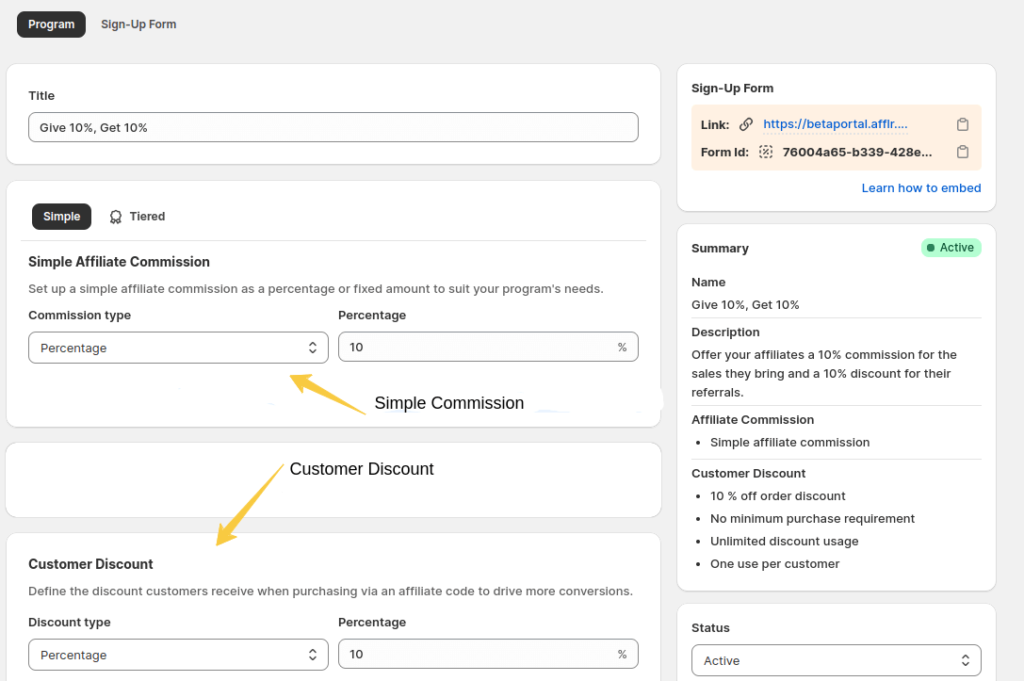
Yuko Affiliate Marketing allows you to easily configure your affiliate program by setting affiliate commission rates and discounts.
For example, you can set a 10% commission for affiliates and a 10% discount for customers on their first purchase. Here is a screenshot of it.
Add Affiliates to Your Affiliate Program
Recruiting good affiliates for your program is an important ( a little hard) part of running affiliate marketing in Shopify.
Not hard because finding them is difficult, but because onboarding can be extremely bemusing and time-consuming.
That is why using signup forms for affiliates from Yuko Affiliate Marketing can be very handy.
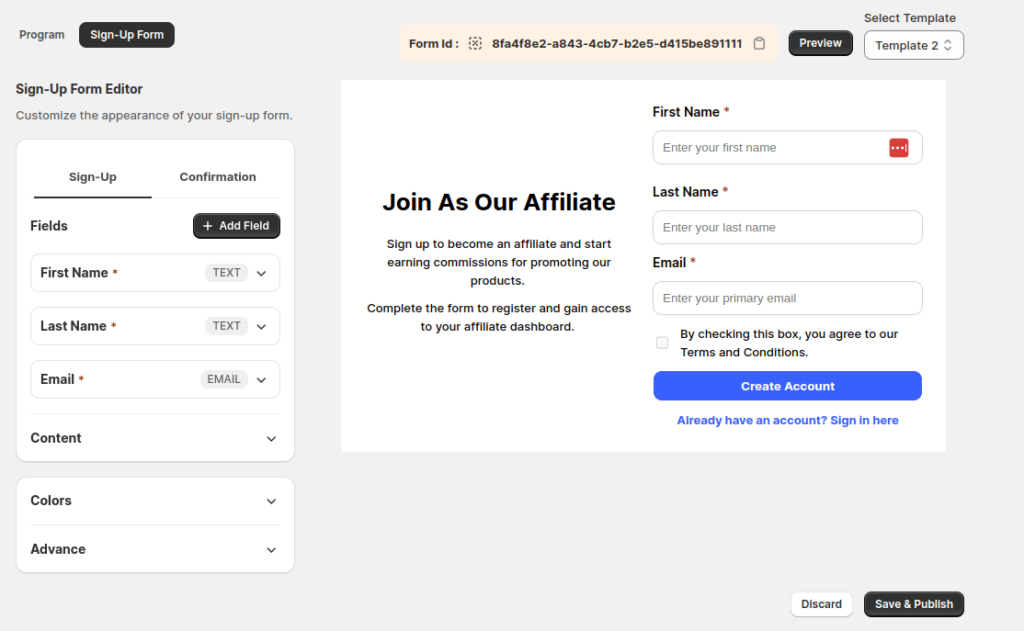
Yuko Affiliate Marketing lets you create a customizable affiliate signup form for your Shopify store.
This page displays your affiliate program details and allows visitors to sign up as affiliates.
To enable this, simply click the ‘Create signup form’ button on each affiliate program’s page.
You will still have control over who can be added as affiliates because you can switch off the ‘Auto approve’ option.
This will enable you to directly convey affiliate partners from Pending -> Approved.
Share Unique Affiliate Links and Codes
Getting your affiliates ready to promote your products requires no time.
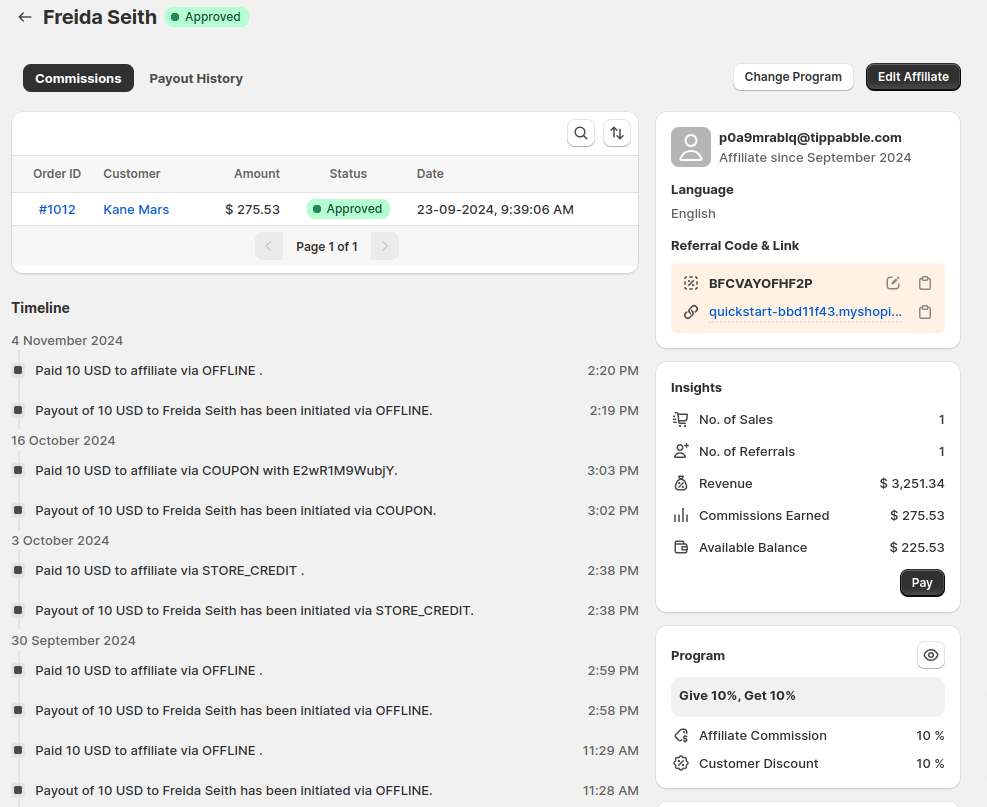
Yuko Affiliate Marketing makes this super simple by automatically creating unique Shopify affiliate links and codes for each affiliate as soon as they are approved.
Every time a customer clicks the link and makes a purchase, the affiliate sale is accurately monitored and recorded by Yuko Affiliate Marketing. Affiliate marketing in Shopify is that simple with Yuko Affiliate Marketing.
But wait, there’s more! Each affiliate also gets its own discount code (referral code).
Customers can use these during checkout or while using mobile phones to get their discount. Your affiliate still gets credit for the sale.
Another exclusive perk? Well, you can personalize these discount codes for your affiliates. This will also keep them excited.
Want to check these links and codes? It’s super easy: If you’re the store owner:
- Head to your Yuko Affiliate Marketing dashboard
- Click on Affiliates and click on your affiliate’s name
Not just links, you will find their entire history there like affiliate sales, affiliate commission, payouts, social media links, etc.
Affiliates might need the same privilege to know their performance, right?
Your affiliates don’t need to bug you for this info either.
They can log into their own affiliate portal and find everything they need right there.
This acts as a dashboard for affiliates.
Monitor Affiliate Performance
Now, you probably want to know if your Shopify affiliate marketing program is actually working, right?
Yuko Affiliate Marketing makes it easy with a real-time dashboard that shows you everything that’s happening.
Curious about your sales?
- Go to your Yuko Affiliate Marketing dashboard
- Click on Sales to see all those affiliate-driven purchases
Want to check commissions?
- Go to your dashboard
- Hit Commissions to see what you owe
Payout Affiliate Commissions
Here’s the best part, paying your affiliates is basically on autopilot with Yuko Affiliate Marketing.
When it’s time to pay, you’ll see everything queued up and ready to go.
- Visit your dashboard
- Go to Payouts and click Pay next to any pending payments

You can also use Yuko Affiliate Marketing for Bulk Payouts for affiliates and never miss a deadline.
With Yuko Affiliate Marketing handling all the technical stuff, you can focus on growing your business.
Managing and Scaling Your Affiliate Program
Based on my experience experimenting with Shopify affiliate marketing campaigns, scaling an affiliate program requires a strategic approach.
Analysts project affiliate marketing will grow at a CAGR of 18.6% globally through 2032, underscoring the long-term scalability of this model.
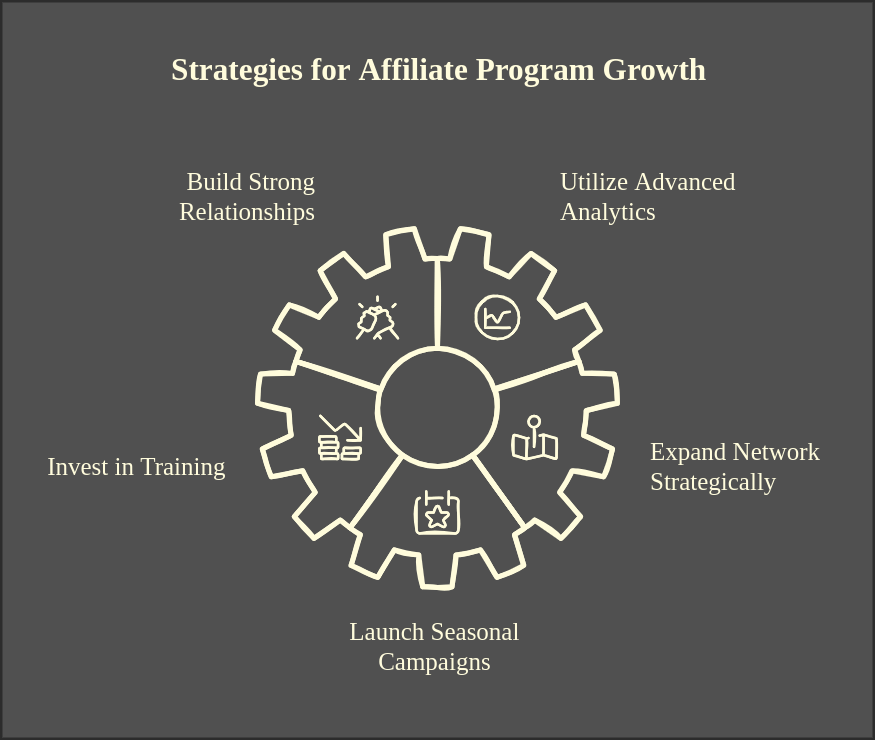
Here are seven actionable steps that I’ve found will work wonders:
1. Build Strong Relationships with Top Affiliates
The best way to forge strong relationships with affiliate marketing top performers begins with genuine and consistent affiliate communication. Your affiliates ought to build trust in affiliate managers and the online marketing team.
2. Utilize Advanced Analytics for Optimization
Use standard key metrics to identify which affiliate partner, campaign, or channel is more successful. Some affiliate app has built-in features to show where growth can be achieved through tweaking. Alter your Shopify affiliate marketing strategy to support scaling.
3. Invest in Affiliate Training and Resources
Give affiliates relevant, professional promotional resources, samples of the product, and informative seminars. I understood the hard way that affiliates given the right tools and knowledge show higher results and have better confidence in promoting your brand.
4. Expand Your Affiliate Network Strategically
There’s an important catch when it comes to scaling, it’s not about growing the number of affiliates; it is about the kind of affiliates. Find out the niche-specific bloggers, influencers, and marketers who cater to your target customers. Find affiliate marketers who are genuinely interested in promoting your products and not just on your commission.
5. Launch Seasonal Campaigns and Incentives
I have noticed that higher engagement happens through seasonal promotions and additional affiliate contests. When affiliates promote the products and their offers during a particular season like black friday affiliate marketing in Shopify, there is high growth in performance metrics.
Advanced Strategies and Tips to Run Affiliate Campaigns
From my experience of doing affiliate marketing for Shopify, these strategies have been absolute game-changers:
Strategy 1: Creating exclusive promotions brings great changes.
Offering a special 25% discount code to top affiliates resulted in better conversion.
Strategy 2: Running affiliate contests
This strategy can energize your entire network. Nothing motivates affiliates more than having an edge for better performance.
Strategy 3: Offer a tiered commission system and bonus for seasonal sales or special products.
For example, during new launches, Shopify affiliate marketing partners who create awareness for those products and sell more can be awarded special gifts.
Strategy 4: Educate your affiliate partners
Support your affiliates to know more about affiliate marketing in Shopify, how they can improve their contribution, and the latest trends in marketing. You can use affiliate program blogs to achieve this.
Measuring ROI: Analyzing the Performance of Affiliate Marketing
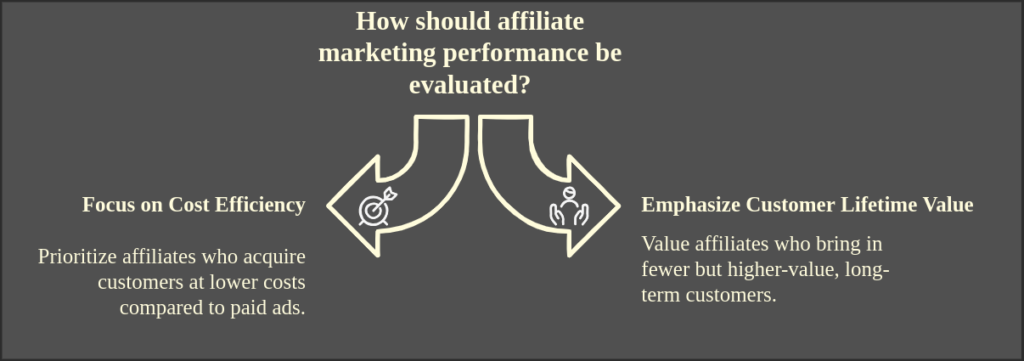
Through studying multiple Shopify affiliate programs, I’ve learned that tracking the right metrics changes everything.
Customer Acquisition Cost (CAC) is a big challenge for Shopify merchants. Hence, track every commission payout against the value of new customers.
Customer Lifetime Value (LTV) is just as critical. I noticed that some affiliates drive fewer signups but attract high-value customers who stay longer and spend more. This insight can reshape how you set affiliate commission rates and incentives.
By combining CAC and LTV, I measure the real ROI of Shopify affiliate marketing campaigns. This ensures you reward the affiliates who deliver sustainable growth, not just quick sales.
Learn more about ROI tracking in my detailed guide on affiliate marketing metrics.
Common Mistakes to Avoid in Affiliate Marketing for Shopify
These are some of the common mistakes I will recommend avoiding while doing affiliate marketing in Shopify.
- Setting unrealistic commission rates
- Poor affiliate tracking implementation
- Lack of affiliate support
- Inconsistent communication
- Infrequent payouts
- Ignoring data analysis
- Not preventing affiliate fraud
Case Study: Success Story Using Affiliate Marketing
Amazon is the most inspiring and successful affiliate marketing story for anyone looking to start their own recommendation marketing journey.
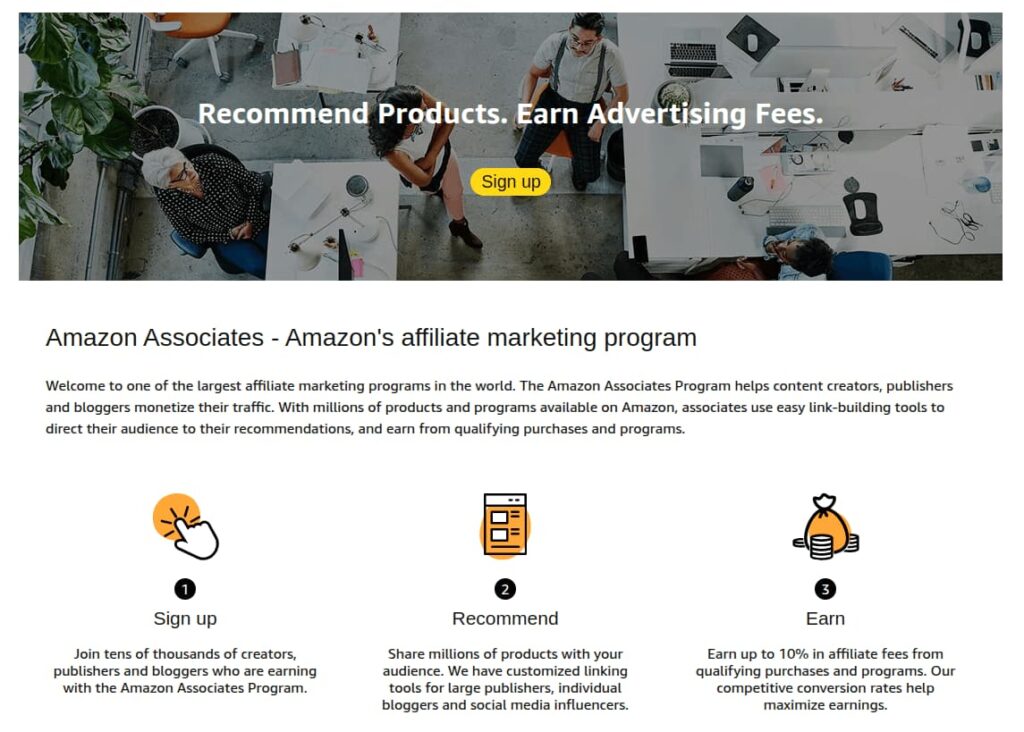
I’ve done enough reading on how Amazon’s affiliate marketing program reshaped e-commerce.
What impressed me most was their growth strategy. They created a true win-win system where affiliates acted as invested partners, not just promoters.
Amazon started small with books before expanding into every niche.
Hence, the lesson for Shopify store owners is clear: dominate your niche first, then scale into other categories.
Their success was not only about attractive Amazon commission rates but also about building a complete affiliate ecosystem. They have clear tracking, reliable payouts, and strong support for affiliates.
I use this as a blueprint when building a Shopify affiliate program.
Hence, by treating affiliates as partners and giving them the tools they need, you can drive sustainable growth, repeat sales, and long-term brand loyalty.
Explore more success stories in our blog on Affiliate Case Study.
Experience the easiest way to grow your Shopify store – set up a personalized affiliate program that brings results.
Conclusion
As someone who regularly concentrates on content that helps e-commerce businesses grow. I hope this complete guide to Shopify affiliate marketing has given you the confidence to begin or optimize your marketing journey.
From understanding the basics and benefits to mastering advanced strategies and avoiding common pitfalls, this guide has everything that is needed for affiliate marketing for your Shopify store.
Related reading
- Affiliate marketing Black Friday guide for 2025 to 2X DTC sales
- How to Create a Shopify Affiliate Link (Guide + Strategies)
- How to Create an Affiliate Form (Templates & Best Practices)
Frequently Asked Question
To start an affiliate program on Shopify, integrate an affiliate app like Yuko Affiliate Marketing into your Shopify store. Set up commission rates, recruit affiliates, and track their performance using the app’s dashboard.
You should decide on affiliate commission based on what’s accepted in your niche. Usually, commission rates range from 5% to 30%. Decide based on your profit margins. Offering competitive rates can attract high-performing affiliates.
The best Shopify affiliate app for beginners is Yuko Affiliate Marketing. It is easy to set up, has automated tracking, flexible payouts, and moreover has a pay-as-you-grow pricing model.
Affiliate tracking for Shopify is handled through apps. Thus, you can easily monitor clicks, sales, and conversions. Moreover, these tools also automate commission calculation and payouts.
Yes, Shopify allows you to run both. Affiliate and referral programs together. Moreover, all-in-one tools like Yuko Affiliate Marketing will help you simultaneously run both smoothly.
To measure the ROI of your affiliate program, track metrics like Customer Acquisition Cost (CAC), Lifetime Value (LTV), and affiliate-driven sales. Then, comparing these against ad spend shows if your affiliate program is profitable.